Artists' Biographies - Ivuka Arts Studio |
||||
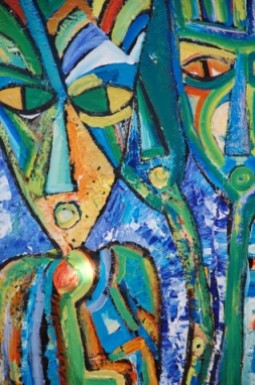 |
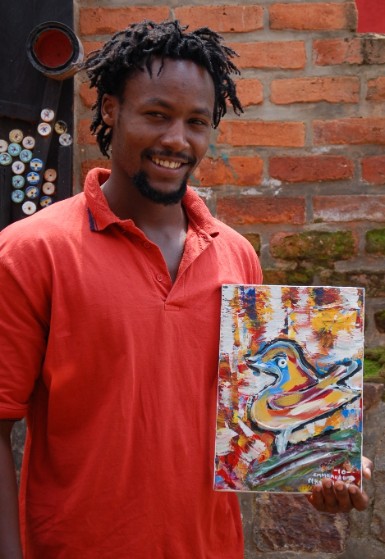
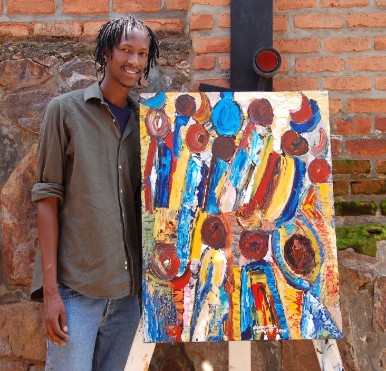
Emmanuel Nkuranga (1987- ) The second born in a family of six boys, Emmanuel lived in Uganda for the first ten years of his life. He describes his parents as “calm and happy” which is very believable when you spend time with the artist. His father is an Anglican priest who went to Uganda to study theology. Emmanuel played a lot of sports during his childhood, such as soccer and basketball, and still does as an adult. This really is not too shocking, because Emmanuel strikes one as a playful person and this exuberance for life translates into his art. The artist moved to Rwanda in 1997 and attended two different high schools. He then attended Kigali Institute of Science and Technology (KIST) and earned a degree in information technology. He speaks English, Kinyarwanda, Luganda, a little Swahili and some French. His mother passed away in 2001. The artist says he is close to his dad and his four brothers who live in Kigali. Emmanuel started his artistic career drawing “Tom and Jerry” style cartoons with his brothers. He says they would draw pictures of every day events like a “dog chasing a car”. While in high school, he visited his uncle, Sanna Gateja, who is a painter and Emmanuel says he got his passion for painting from him. Then he met Collin Sekajugo, a well known Rwandan artist, and Collin inspired him “to start playing with paintings”. It was 2004 when Collin showed him how to transform sketches into paintings and made him believe art was “doable”. Nkuranga does paintings and mixed media works and has also done a few found object pieces. He uses acrylic on canvas and also local materials, like the woven circles often worn as earrings by women in Rwanda. He prefers to work in a semi-abstracted style. Activity (2010), shown below, portrays three women bent over their washtubs “working according to the pattern of Rwandan society”. The artists reveals that he mixes fast dry paints usually used for cars with his acrylic and then shapes the paint with his palette knife. The car paint becomes soft when mixed with acrylic. This innovation has allowed the artist to create a medium he can really mold to his desires. Bark from a tree has become an integral part of the canvas surface at the top of this work. A truly monumental and beautifully vibrant work, Birthday (2010) reveals the artist’s ability to “play” at paining as he says. The bright red background and pieces of local fabric play off of each other and serve to highlight the two main figures. One is playing a drum and the other is drinking from a traditional container, perhaps milk or beer. This is a traditional birthday celebration in Rwanda. The artist has also incorporated the traditional woven circles worn as earrings here to define the faces of the figures. Home Again (2010) strikes you first with its shear beauty and its unusual shape. Painted on a large leaf from a palm tree that the artist brought from Tanzania and then dried, the piece shows four fish “feeling good in the water” and “going home again.” Emmanuel says he wanted to explore working on different materials. The playful quality of Emmanuel’s work is consistent with his nature. His art is playful, but no less mature or beautiful, for that quality. And Emmanuel is very serious about helping orphans through his program called Art with a Mission. This project which he started in 2010, involves the artist and his friends going to two different orphanages, MPORE, in Gikondo, Rwanda and a FIDESCO orphanage in Kigali. They bring supplies with them and give the teenagers, ages 14 to 17, lessons in “playing with painting.” They try to hold classes two times a week. Emmanuel had an exhibition at the Kigali International Airport where half of the proceeds went towards his program. The artists is multitalented and has designed websites for
other artists and also creates pieces which incorporate old machine parts, such
as pieces of radios and even motherboards.
One gets the sense that Emmanuel really enjoys exploring and playing
with new media. He often uses the expression
“playing with painting” and it is so apt as he clearly enjoys creating his
beautiful pieces and the viewer can then vicariously participate in the play
and the fun. In addition, the viewer
absorbs the beauty of his works and an understanding of Rwandan culture in the
same moment. One wonders where the
artist will go next on his exploration of art. Valerie Ficklin, M.A. (If you would like to
contact the artist, you can reach him at emmamain23@gmail.com.) 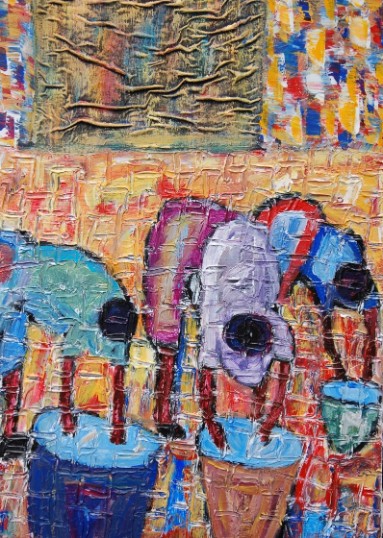 |
|||
