Richard "Safari" Karekezi (1983- )
Richard "Safari" Karekezi was born in Mityana, Uganda which explains his interesting name. He says that his family immigrated to Uganda in the 1970's and that they stopped using their real family name and started using “Safari” instead so that they wouldn't be killed for “being Rwandan.” His family stayed in Uganda until 1997, although Richard and his father came back to Rwanda for a visit in 1995, the artist's first time ever to see his homeland. He says that growing up in Uganda, he was always asking his mother, “Where is my country?” and how to find Rwanda on a map. In 1997, Richard and his whole family moved back to Kicikiru, just on the outskirts of the main part of Kigali. In this same year, the artist started attending Rwanda International Academy, which was a secondary boarding school taught in English. Upon finishing this school, Richard says he was “really into art.” The artist says he had always loved art. As a child, he did cartoons, sketching characters like the Pink Panther, for which the other children would pay him. He took art classes twice in Uganda at the Catholic school he attended. At the Academy, there was an art teacher who inspired him as well.
In 2002, Richard met the person pivotal to his becoming a professional artist: Collin Sekajugo. Richard showed Collin his file of work that he had done in Uganda and Collin was impressed. Collin started Richard off by teaching him the basics, showing him how to mix paint, how to use stencils, and set him up doing signposts for payment. Collin led Richard to do research on the internet. He says that one time when Collin was leaving the country for awhile, he told Richard to “stick to art, that art never rots, it never dies, and you should always keep it in your heart.” Karekezi says in the beginning he had to use house paint and even now this type of paint reminds him of those early days.
Richard strikes one as very philosophical, very much a visionary. His dream is to have an art library. He loves research and says “all design is for the artist”, which he very much proves by his desire to one day build a robot. He is interested in the central nervous system and anatomy of the human body. He does sculptures as well as paintings, and one day dreams of having one of his statues at the center of a roundabout in Kigali.
His work entitled Different People, Different Faces (2009), shown above with artist, portrays how people from different countries have different faces and heads and the resulting beauty and rhythms of this diversity. This work is done in acrylic paint and charcoal. He started using charcoal in 2003 after having accidentally knocked a clay oven onto a painting and sprinkling it with charcoal, but loving the effect it created.
Richard then applied this same concept to another series. Evening Aroma and Morning Tea, shown in detail at right, both belong to his 2010 series Tea Table Family. These paintings incorporate actual tea on their surface to give definition and texture to the works. Richard Safari, as his friends sometimes call him, says Evening Aroma is about “people sitting down to enjoy their tea and making plans.” The works are about everyday life, that “good moods lead to good growth.”
Together We Are (2010), pictured right, shows a zebra, buffalo, and antelope all eating grass. He says that the work is about the relationship between the animals, similar to that of brothers and sisters in the human world. Richard has kept his palette very minimal, duo chromatic almost. The charcoal here serves to define the animals and gives the look a wild and bold look. The way that all three animals stare out at the viewer make this piece almost confrontational and a little unnerving, kind of what it would be like to come upon these animals in the wild in real life.
In Rwanda, mothers always carry their babies on their backs. Richard says Mother Care (2010), below, is about the process of mothers caring for their children. This tribute to what mothers do for their children reminds one of the French Fauves or the Impressionists, the way the colors seem to form the shapes themselves. Color, in fact, appears to be the dominating force in this painting. The “bubbles” of color, as the artist describes them, dance around the woman's head and show her thoughts and feelings: Love, pride, and probably some worry. The artist perfectly matched a beautiful and lyrical style to a feminine and touching subject.
These works make it easy to understand why the artist received fourth place in the Rwanda Jeu de la Francophonie held at Amahoro Stadium and then went on to receive first place at the culminating competition in Beirut, Lebanon in 2008 and 2009.
Richard “Safari” Karekezi lives up to his interesting name, both as an artist and a philosopher. He has come a long way from sketches of the Pink Panther and using house paints. Richard exhibits regularly at Uburanga Art Studio in Kimihurura. If you are lucky enough to catch him at the studio for some conversation, then you are in for a real adventure, dare one say, a real “Safari”?
Valerie Kanney Ficklin Art Historian, M.A. | 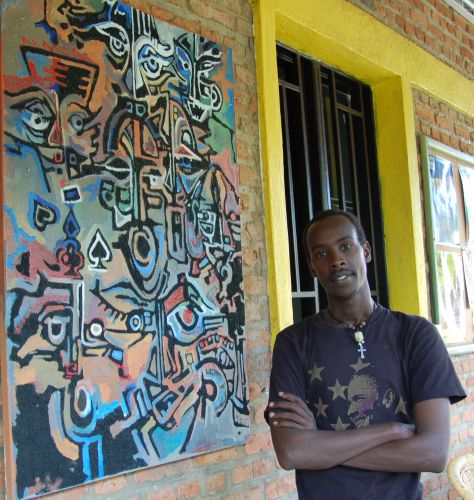 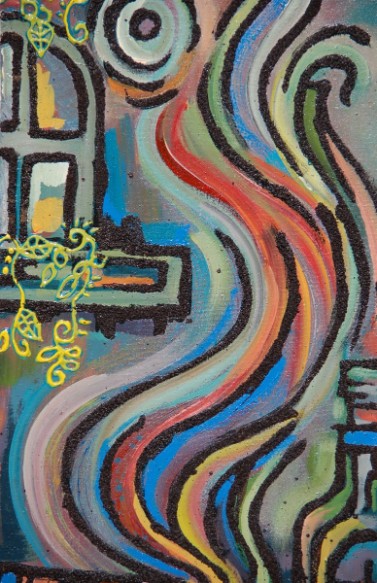 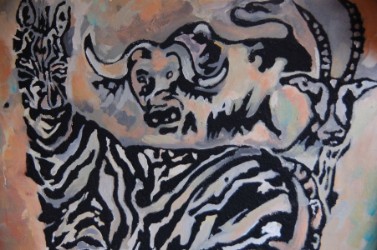 |
